

Machined Review 2026: Content Cluster Automation Tested
Machined is one of the few tools that treats a content cluster as the unit of work rather than a single article. Instead of prompting for one post at a time, you enter a topic and the platform researches related keywords, plans a pillar-and-supporting structure, writes the articles with citations, interlinks them, and pushes them to WordPress or Webflow. This review breaks down where that workflow genuinely saves time, where it still needs a human editor, and which teams get the most value from it.
What Machined actually does
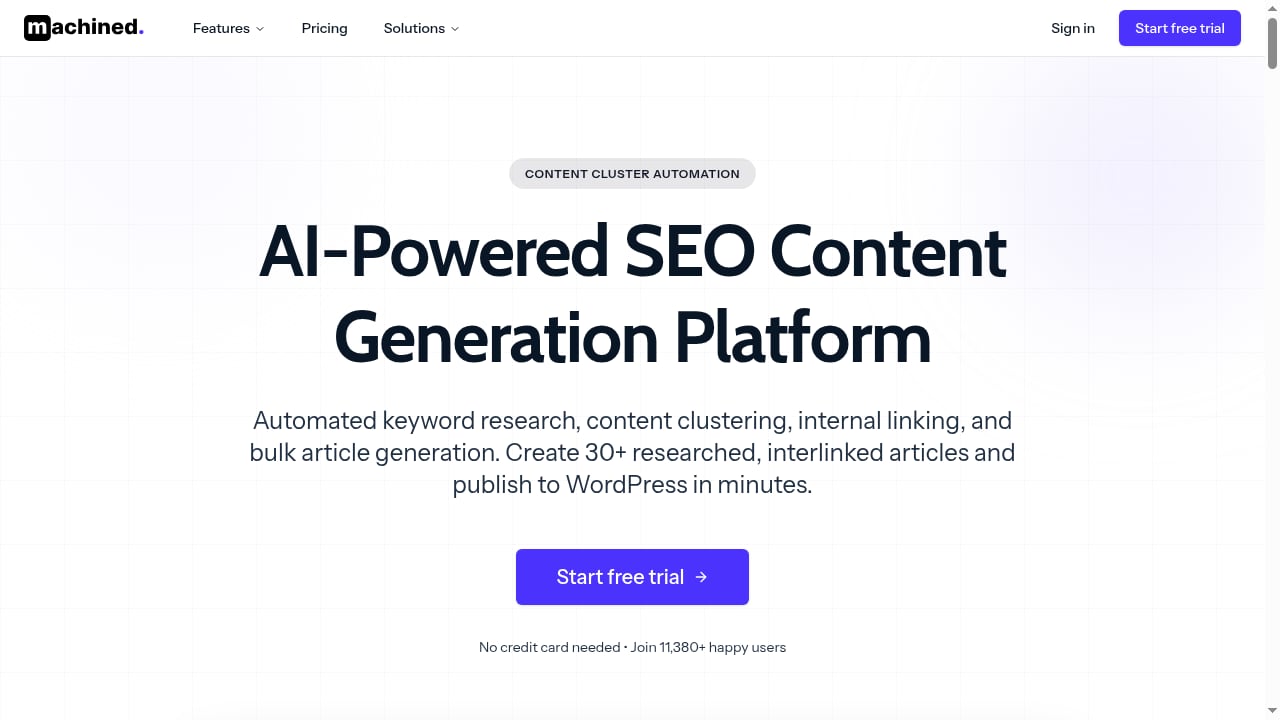
First viewport screenshot of Content Cluster Automation Platform | Machined.
Machined is an AI SEO content generation platform built around topical authority. The core loop is short:
- Enter a topic plus audience and language.
- Build a cluster — the platform researches related keywords and groups them into a pillar page and supporting subtopics.
- Generate content for the whole cluster, with research and citations attached.
- Add internal links automatically between related articles in the cluster.
- Publish directly to a connected CMS or via webhook.
That sequence matters because most AI writers stop at step 3. The clustering and interlinking steps are what turn a pile of articles into a structure that search engines and AI answer engines can read as a coherent body of expertise.
The clustering engine
When you give Machined a broad topic, it expands it into a keyword map and assigns roles: one pillar piece targeting the head term, and supporting articles targeting long-tail and question-style queries. This is the same manual process SEO teams run in spreadsheets, compressed into a few minutes. The output is a plan you can review before spending generation credits, which is the right place to catch a bad topic expansion.
AI writing with citations
Generated articles include research references rather than unsupported claims. In practice this reduces the fact-checking burden, but it does not remove it. Citations can point to weak or tangential sources, so a review pass is still required before publishing anything that touches money, health, or legal topics.
Automated internal linking
Internal links are inserted between articles in the same cluster based on semantic relevance. This is the feature that most clearly separates Machined from general-purpose AI writers, and it is also the feature most likely to need manual tuning. Automated anchors can be repetitive, and links only make sense once the supporting articles actually exist and are published.
Publishing and integrations
Direct integrations cover WordPress and Webflow. For everything else, webhooks connect through Zapier, Make, or n8n, which means most modern CMS and static-site setups can be wired in without custom development.
Who Machined is built for
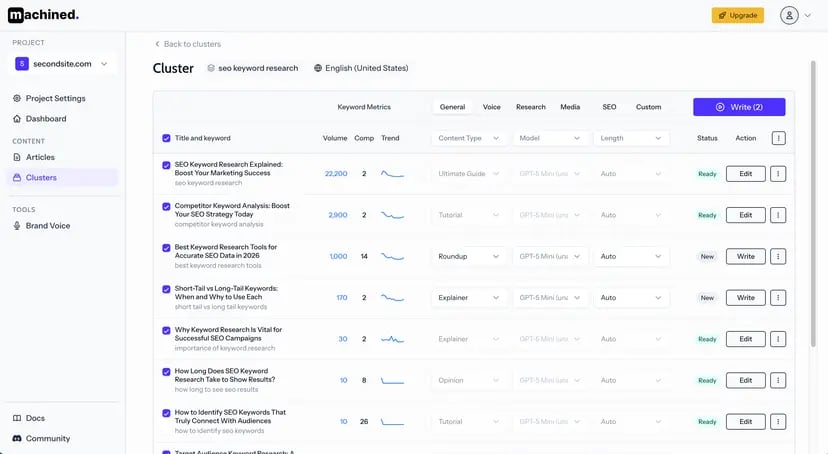
Content Cluster Automation Platform | Machined product interface.
Machined fits teams that need volume and structure at the same time. Based on the public feature set and pricing tiers, four profiles stand out:
- SEO agencies managing multiple client sites who need cluster plans and drafts fast, then apply their own editorial layer.
- Affiliate and niche site operators building topical authority across many small sites where per-article cost dominates the decision.
- In-house marketing teams with tight budgets that need to scale publishing without adding headcount.
- E-commerce and publisher teams with large category structures that map naturally onto cluster hierarchies.
It is a weaker fit for brands whose differentiation depends on a highly specific voice, original photography, or a defined conversion funnel baked into every post. Those needs are better served by tools with a learning loop or by a human-led editorial process.
Strengths
Genuine end-to-end cluster automation. Keyword research, planning, generation, interlinking, and publishing live in one workflow. That is rare, and it removes the most tedious part of SEO content operations.
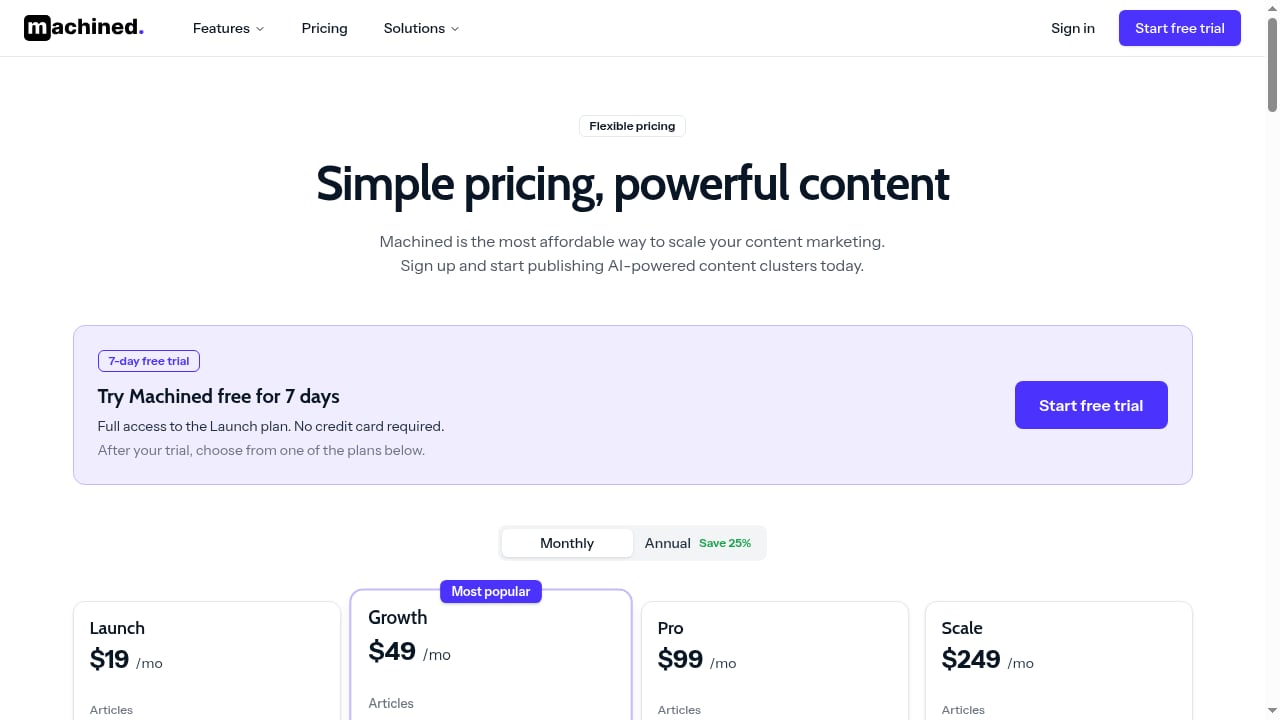
Low entry price with high-volume tiers. Public comparisons put entry plans around $19/month, with upper tiers reaching roughly $249/month. There is also a bring-your-own-key option at about $99/month for 2,000 articles, where you supply your own Anthropic, OpenAI, Google, or OpenRouter key and pay the provider directly at cost. For high-volume publishers, BYOK removes token markup and makes unit economics predictable.
Fast, hands-off publishing. WordPress and Webflow publishing plus webhook support means the tool fits existing pipelines instead of forcing a migration.
Cannibalization control by design. Because the cluster is planned as a set, articles target complementary queries rather than competing for the same term.
Limitations and honest trade-offs
First viewport screenshot of Case Studies | Machined.
No learning loop from your edits. Machined generates from your inputs but does not appear to adapt to your edits and ratings over time. Article 30 is not meaningfully more on-brand than article 1 unless you change your inputs. Teams that want quality to compound from feedback should weigh alternatives carefully.
AI-generated images only. There is no native path to upload your own brand photography, which matters for sites where visual consistency is part of trust.
No built-in conversion funnel. A site-wide CTA and product-link layer is not part of the feature set, so turning readers into leads requires manual work or a separate tool.
Review is mandatory. Every credible source on Machined notes the same caveat: AI-generated content still needs human review. At scale, that review becomes the real bottleneck, not generation.
Cost scales with volume. The entry price is attractive, but large-scale plans add up. Budget for the tier that matches your actual publishing cadence, not the one that looks cheapest.
SEO-first, not analytics-first. Machined executes a strategy well. It does not provide deep AI visibility tracking or competitive GEO analytics, so it pairs better with a measurement tool than it replaces one. If analytics depth is your priority, see our Writesonic review for a contrasting approach.
Pricing signals
Pricing is the most volatile part of any review, so treat these as directional:
| Tier | Approximate price | What it signals |
|---|---|---|
| Free | $0 | Trial the clustering workflow before committing |
| Launch | ~$19/mo | Low-cost entry, modest article volume |
| Growth | Mid tier | Higher volume for active blogs |
| Pro | Upper tier | Agency and multi-site use |
| Scale | ~$249/mo | High-volume publishing |
| BYOK | ~$99/mo for 2,000 articles | Pay your LLM provider at cost |
The BYOK tier is the most interesting signal. It tells you Machined expects high-volume users to care about token economics, and it shifts the cost conversation from subscription price to provider usage. Always confirm current numbers on the official site before buying, because tiers and limits change.
Setup: what the first week looks like
Setup is light, but the first cluster is where you learn the tool.
- Connect your CMS. WordPress or Webflow via native integration; anything else via Zapier, Make, or n8n webhook.
- Define your topic and audience. Be specific. "Personal finance for freelancers" produces a better cluster than "finance."
- Review the generated cluster plan. Cut weak subtopics and merge overlapping ones before generating.
- Generate the pillar first. Read it end to end. If the pillar is off, the supporting articles will inherit the problem.
- Generate supporting articles, then audit the internal links. Fix repetitive anchors and add links to your existing evergreen pages.
- Publish in batches. Publishing an entire cluster the same day looks unnatural; stagger it over one to two weeks.
Expect the first cluster to take a few hours of human review. Subsequent clusters go faster once your review checklist is stable.
How Machined compares to alternatives
First viewport screenshot of Pricing | Machined.
Machined sits in a crowded category, and the right choice depends on which part of the workflow you want automated.
- Against Writesonic: Machined wins on cluster execution and entry price. Writesonic wins on AI visibility tracking, GEO analytics, and enterprise compliance. If you already have content and need to know how LLMs treat your brand, Writesonic is the stronger pick.
- Against learning-loop tools: Platforms that adapt to your edits and ratings produce content that improves over time. Machined holds quality flat unless you change inputs. High-volume publishers who accept that trade-off get more articles per dollar; brand-sensitive teams usually do not.
- Against repurposing engines: Tools focused on turning existing assets into new formats solve a different problem. If your bottleneck is distribution rather than net-new clusters, see our roundup of AI content repurposing and publishing automation platforms.
- Against full content operations suites: Broader platforms bundle visibility tracking, workflow management, and publishing. For a wider field, our top 10 AI-powered SEO content creation platforms ranks the category by SEO depth and automation.
For a head-to-head breakdown with two common alternatives, see AgentBooks vs Koala AI vs Machined.
Decision criteria: should you buy Machined?
Score yourself honestly on these five questions.
1. Is your bottleneck volume or quality? If you need many structured articles and can staff a review layer, Machined is efficient. If quality per article is the constraint, look elsewhere.
2. Do you publish to WordPress or Webflow? Native integrations make the workflow genuinely one-click. Other stacks work, but require webhook setup.
3. Do you have an editorial reviewer? Without one, the output will read like unreviewed AI content, and that is a ranking and trust risk.
4. Do you need conversion infrastructure? Machined does not manage CTAs or product funnels. If lead generation is the goal, plan for that separately.
5. Is your volume high enough for BYOK? If you are publishing hundreds of articles monthly, the bring-your-own-key tier changes the math in your favor.
If you answered yes to volume, WordPress or Webflow, and a review layer, Machined is a strong fit. If you answered no to the review layer or yes to needing a learning loop, keep evaluating.
Related reading
- Public Product Knowledge Content: Definition, Value, and Implementation Methods - How is public product knowledge content defined, why does it matter, and how do you implement it? This article breaks down knowledge bases, RAG, content automation, and compliance essentials, with an actionable checklist.
- Top 10 AI Search Visibility & Content Operations Platforms 2026 - We ranked 10 AI search visibility and content operations platforms for 2026 by GEO tracking, content workflow depth, integrations, and pricing evidence.
- Kompozy Review 2026: Honest Look at AI Content Engine - Evidence-based Kompozy review: how its AI repurposing engine works, real pricing signals, ideal users, limitations, and whether it beats the content treadmill.
Sources and further reading
- overrank vs Machined: an honest comparison (2026) - Machined is the closest tool to overrank: it automates topical content clusters and publishes them for you, starting at just $19/mo. The difference shows up in what happens after each article is published.
- Machined: Content Cluster Automation Platform for SEO - Learn how Machined automates SEO content clusters, keyword research, content planning, internal linking, and topical authority for scalable organic growth.
- Machined vs. Writesonic: Which AI Tool Is Right for You? - A comprehensive comparison of Machined and Writesonic AI content platforms. Learn which tool best fits your needs for content clustering, SEO optimization, and GEO analytics.
FAQ
Is Machined good for SEO? Yes, for structure. The cluster model, complementary keyword targeting, and automated internal linking address the mechanics of topical authority. Ranking outcomes still depend on content quality, site authority, and competition.
How much does Machined cost? Public sources point to a free tier and paid plans from roughly $19/month up to about $249/month, plus a bring-your-own-key plan near $99/month for 2,000 articles. Verify current pricing on the official site.
Does Machined publish directly to WordPress? Yes. WordPress and Webflow have native integrations. Other platforms connect through webhooks with Zapier, Make, or n8n.
Does Machined learn from my edits? Based on available comparisons, it does not appear to adapt to your edits and ratings over time. Quality stays consistent with your inputs rather than compounding with feedback.
Can I use my own AI API key? Yes. The BYOK plan supports Anthropic, OpenAI, Google, and OpenRouter keys, letting you pay your provider directly at cost.
Is AI-generated content from Machined safe to publish? Only after human review. Citations reduce but do not eliminate fact-checking, and unreviewed AI content carries ranking and trust risks.
Conclusion
Machined solves a specific, real problem: producing interlinked content clusters without running the whole process by hand. Its clustering engine, automated internal linking, and direct publishing make it one of the more efficient options for teams that need structured volume at a low entry price, and the BYOK tier is a smart move for high-volume publishers watching token costs.
The trade-offs are equally clear. No learning loop, no brand-image uploads, no conversion funnel, and a mandatory human review step. None of those are dealbreakers for an agency or niche publisher with an editor in the loop. They are dealbreakers for a brand that needs every post to sound unmistakably like itself.
Buy Machined if you want cluster volume and structure with a review layer you control. Skip it if your priority is adaptive brand voice, visual consistency, or built-in conversion design. For a broader view of how it stacks up, start with our comparison of AgentBooks, Koala AI, and Machined.